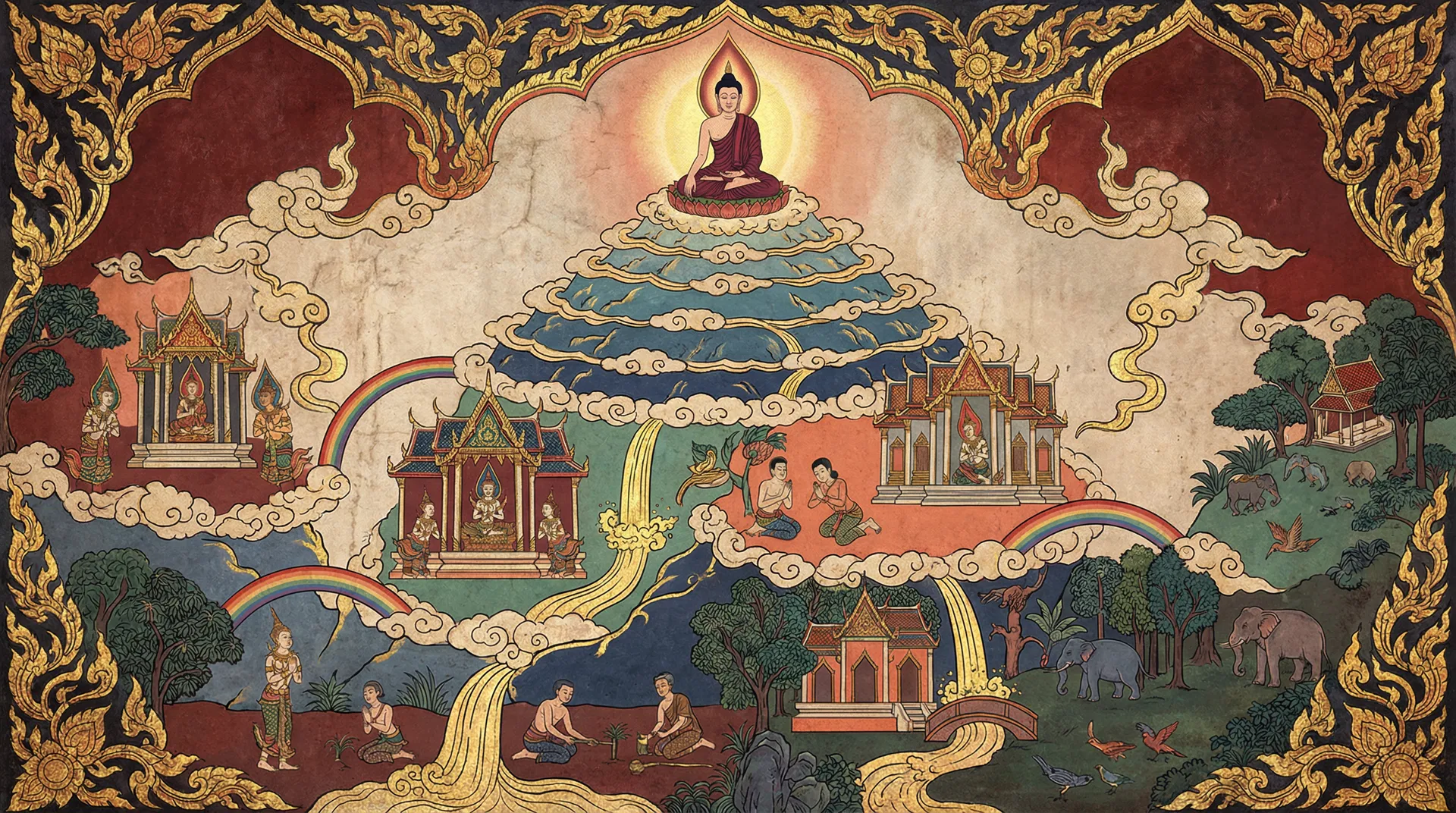
Sama Jātaka
Sama Jātaka
In the dense, verdant forests that bordered the kingdom of Kosala, lived a sage named Sama. He was a man of profound renunciation, who had left behind the world of human affairs to dedicate his life to asceticism and meditation. He resided in a simple hermitage, nourished by the fruits of the forest and the purity of his own mind. His only companion was his devoted wife, Sunanda, who shared his life of piety and simplicity.
Their lives were a testament to peaceful existence, filled with the chirping of birds, the rustling of leaves, and the gentle murmur of the nearby stream. Sama spent his days in deep contemplation, seeking to understand the nature of reality and to cultivate boundless compassion. Sunanda, with unwavering devotion, managed their humble abode and supported her husband in his spiritual pursuits.
One day, while Sama was meditating by the river, a hunter, driven by greed and a craving for sport, lay in wait. This hunter, named Pāyāsi, was a man whose heart was hardened by his cruel profession. He cared little for the sanctity of life, seeing only prey. He aimed his bow and arrow at the meditating sage, his intent fueled by a perverse thrill.
Just as the hunter was about to release the arrow, a divine intervention occurred. A celestial being, a guardian of the forest who had long observed Sama’s virtuous life, descended from the heavens. This being, sensing the impending danger, struck the hunter’s bow with a divine force, causing the arrow to veer wildly off course and embed itself harmlessly in a tree trunk.
Pāyāsi, startled and bewildered, looked up to see the celestial being. The apparition, with a voice that resonated with divine authority, rebuked the hunter. “Cease your wicked deeds, hunter! This sage lives a life of purity and devotion. Your arrow, meant to end his life, has been turned aside by the forces of righteousness. You bring only ill fortune upon yourself with such actions.”
The hunter, struck by fear and awe, dropped his bow. He had never encountered such a phenomenon, and the words of the celestial being pierced his hardened heart. He looked at Sama, who had opened his eyes and was gazing at him with a look of calm understanding, not anger or fear.
Overwhelmed by the experience, Pāyāsi fell to his knees. He confessed his wicked intentions and begged for forgiveness. The celestial being, seeing the genuine remorse in the hunter’s heart, granted him absolution, but warned him sternly to abandon his cruel ways and to seek a more righteous path.
Sama, with his characteristic compassion, approached the hunter. “Fear not, friend,” he said gently. “Your heart has seen the error of its ways. Let this be a turning point for you. Let go of the desire to harm, and embrace the path of kindness. The forest provides enough for all, without the need to take life.”
The hunter, deeply moved by the sage’s forgiveness and the celestial intervention, vowed to change his ways. He renounced hunting and dedicated himself to a life of honesty and compassion. He began to practice kindness towards all beings, finding contentment in simple living and the company of nature.
Years passed. The hunter, now a reformed man, lived a life of exemplary virtue. Sama continued his ascetic practices, his devotion unwavering. Sunanda, his wife, remained his steadfast companion in their life of spiritual pursuit.
One day, a great famine struck the land. Crops failed, and food became scarce. The people of the nearby villages, desperate and starving, ventured into the forest in search of sustenance. In their desperation, some began to hunt indiscriminately, their fear overriding any sense of compassion.
Sama, seeing the suffering of both humans and animals, knew he had to act. He and Sunanda, despite their own meager provisions, began to share what little they had with the starving villagers. They offered wild fruits, roots, and herbs, guiding the villagers on how to find edible plants and warning them against poisonous ones.
However, the famine worsened, and the villagers’ desperation grew. Some, in their hunger, began to eye the forest’s inhabitants with renewed predatory intent. Sama, understanding their plight but also the grave consequences of further violence, decided to undertake a great act of compassion. He declared to his wife and the villagers that he would go to the King’s court to plead for relief.
Sama, with Sunanda’s blessing, journeyed to the capital. He presented himself before the King, a man known for his piety and justice. Sama, with eloquence and deep conviction, described the dire situation in the forest and the suffering of both his community and the wild creatures. He implored the King to send aid and to implement measures to alleviate the famine.
The King, moved by Sama’s plea and the purity of his intentions, ordered immediate relief to be sent to the forest. Food supplies, grains, and other necessities were dispatched. The King also decreed that hunting would be strictly prohibited during the famine, to protect the remaining wildlife.
When Sama returned to the forest with the King’s aid, he was met with immense gratitude. The villagers rejoiced, and the animals, sensing the shift in the environment, found respite. The former hunter, Pāyāsi, now a respected elder in the community, was instrumental in organizing the distribution of aid, ensuring that it reached everyone fairly.
The famine eventually subsided, and the forest began to heal. Sama and Sunanda continued their peaceful existence, their lives a beacon of compassion and resilience. The story of Sama, the sage who faced potential death with equanimity and whose compassion extended to all beings, became a revered tale, reminding people that even in the darkest of times, kindness, forgiveness, and a commitment to non-violence can bring salvation and restore balance.
— In-Article Ad —
💡Moral of the Story
Compassion, forgiveness, and non-violence are virtues that not only protect oneself but also extend their blessings to others, bringing salvation and restoring balance even in times of great hardship.
Perfection: Compassion (Karunā) and Non-violence (Ahiṃsā)
— Ad Space (728x90) —
More Jataka Tales You May Enjoy
 150Ekanipāta
Mahapada Jataka
Mahapada JatakaIn the ancient and prosperous city of Varanasi, there reigned a king named Bodhisatta...
💡 The greatest gift a ruler can give to their people is the teaching of righteousness and virtue (Dhamma), which leads to inner peace, wisdom, and lasting happiness.
 218Dukanipāta
Masa Jataka
Masa JatakaIn a serene monastery nestled amidst rolling hills, lived a devout monk named Bodhisattva...
💡 Attachment to desires and possessions leads to suffering. True contentment comes from inner peace and detachment, not from external things.
71EkanipātaThe Jataka of the Clenched Fist
In a time long past, in the prosperous city of Varanasi, the Bodhisatta was born as a young Brahmin ...
💡 True leadership lies in protecting the vulnerable, even at great personal risk.
 253Tikanipāta
Kusa-Jātaka
Kusa-JātakaIn the kingdom of Kampilla, nestled beside the sacred River Ganges, lived a king named Ud...
💡 Jealousy and hasty judgments can lead to terrible suffering and separation. True love is tested by adversity, and forgiveness is essential for healing and reconciliation. Patience, inner strength, and understanding are virtues that can overcome even the most profound injustices.
222DukanipātaMulapariyaya Jataka
Mulapariyaya JatakaIn the vibrant city of Savatthi, where merchants plied their trade and scholars d...
💡 True wisdom lies not in the accumulation of knowledge, but in understanding the fundamental nature, essence, and interconnectedness of all things. Humility is the gateway to genuine understanding.
9EkanipātaThe Generous Merchant
The Generous MerchantIn the bustling port city of Bharuch, where the air was thick with the scent of...
💡 True wealth lies in selfless giving, which ultimately brings its own abundant rewards.
— Multiplex Ad —